Becoming the Roswell Museum and Art Center
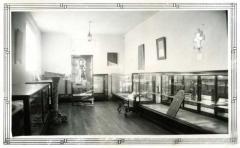
IntroductionThe arrangement between the FAP and the Chaves County Archaeological and Historical (A&H) Society had enabled the Roswell Museum to provide a variety of exhibitions and programs to its visitors, but it also caused tension between federal staff and local leadership due to differing expectations. While the FAP emphasized classes and rotating art exhibitions, the A&H Society wanted to focus on archaeological materials. As early as 1938, the Roswell Museum’s sponsors expressed concern over the FAP’s focus on art exhibits rather than archaeological ones and investigated a potential partnership with the Museum of New Mexico to bring more historical materials to Roswell.
Tensions became more pronounced during the 1940s, when the focus of community art centers shifted toward serving enlisted troops. Art centers became known as Service Centers, and began hosting exhibitions that addressed the Red Cross and other wartime interests. By July 1942, the Roswell Museum’s sponsors decided to end their federal affiliations and run the center themselves. The museum returned its FAP equipment to Santa Fe at the end of the year, and remaining staff members were assigned new positions with other projects.
The Roswell Museum's separation from the FAP ultimately fulfilled the long-term objective of the Community Art Center Project, which was to have local communities assume control of these centers. The Roswell Museum's transition into a city department also indirectly secured its future as a cultural institution. With US involvement in World War II well underway by 1942, the WPA was no longer considered necessary to the economic recovery of the United States. It officially ended its operations in 1943, and the art centers that still depended on it for funding and staffing closed. Although the Roswell Museum scaled back its operations due to wartime priorities and a reliance on volunteer staff, it remained open, hosting regional traveling exhibitions and providing arts access to troops training at the Roswell Army Air Field.
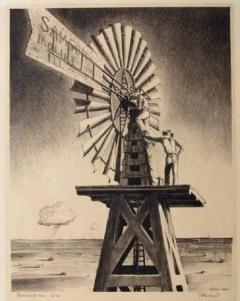
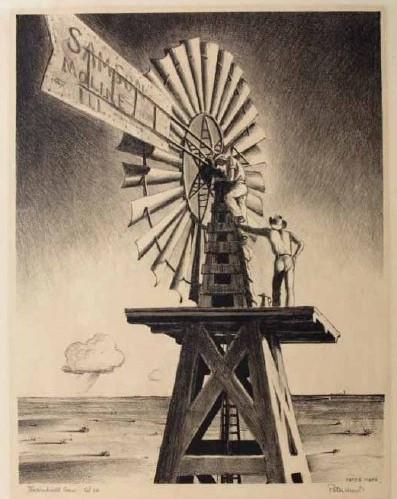
A series of donors reenergized the museum during the late 1940s. Donald Winston, a petroleum businessman, instigated a renewed interest in collecting when he donated a set of Roswell artist Peter Hurd’s lithographs. Together with his brother, Frederick, and business partner, geologist Samuel Marshall, Winston established the museum’s collection of New Mexican modern art, donating works by Peter Hurd, Henriette Wyeth, Georgia O’Keeffe, Stuart Davis, and others. In 1949, Esther Goddard, the widow and collaborator of pioneering rocket scientist Robert H. Goddard, offered her late husband’s launch tower to the museum, instigating the Goddard collection. Rogers Aston, a petroleum businessman and bronze sculptor, created the Rogers Aston Collection of the American West, while Donald B. Anderson, another oil businessman and artist, strengthened the museum’s contemporary art holdings and established the Roswell Artist-in-Residence Program. To properly house these burgeoning collections, the museum began to expand its gallery spaces and professionalize its staff, with its first director being none other than Thomas Messer, later director of the Solomon R. Guggenheim Museum in New York. Today, the Roswell Museum’s collections include more than 8,000 objects, and its education spaces encompass classrooms, an auditorium, an extensive ceramics studio, and the Goddard Planetarium. To learn more, you can visit its website here.
The Roswell Museum and Art Center has evolved dramatically since 1937. Yet throughout its history, it has remained committed to the education-based ideals of the FAP. While the ways in which the museum engages the public have changed, enriching southeast New Mexico through art and history remains a core objective. By thriving as a community-minded institution, the Roswell Museum and Art Center continues to recognize its WPA origins.
References
Grieve, Victoria. The Federal Art Project and the Creation of Middlebrow Culture. Urbana and Chicago: University of Illinois Press, 2009.
Art in Action: American Art Centers and the New Deal. Edited by John Franklin White. Metuchen, NJ: The Scarecrow Press, 1987.
All other documents come from the Roswell Museum and Art Center WPA archive.
Robert Sprague to Russell Vernon Hunter, February 21, 1938.
Bertha Rose, FAP Form 7, Monthly Report, March 1942.
Bertha Rose to Russell Vernon Hunter, June 24, 1942.
Bertha Rose to Russell Vernon Hunter, July 27, 1942.
Russell Vernon Hunter to Bertha Rose, July 28, 1942.
Russell Vernon Hunter to Bertha Rose, December 30, 1942.
Bertha Rose to Russell Vernon Hunter, October 8, 1942.
Roswell Museum Bulletin, no. 1 (February-March 1949).

This page has paths:
- Who Worked Here? Sara Woodbury
- Becoming the Roswell Museum and Art Center Sara Woodbury
- Becoming the Roswell Museum and Art Center Sara Woodbury
- Becoming the Roswell Museum and Art Center Sara Woodbury
- Becoming the Roswell Museum and Art Center Sara Woodbury
- Becoming the Roswell Museum and Art Center Sara Woodbury
- Becoming the Roswell Museum and Art Center Sara Woodbury
- Becoming the Roswell Museum and Art Center Sara Woodbury
- Becoming the Roswell Museum and Art Center Sara Woodbury
- Becoming the Roswell Museum and Art Center Sara Woodbury
- Becoming the Roswell Museum and Art Center Sara Woodbury
- Becoming the Roswell Museum and Art Center Sara Woodbury
- Community Relations Sara Woodbury
- An Art Center Opens Sara Woodbury
- Becoming the Roswell Museum and Art Center Sara Woodbury
- Becoming the Roswell Museum and Art Center Sara Woodbury
- Becoming the Roswell Museum and Art Center Sara Woodbury
- Other New Mexico Art Centers Sara Woodbury
- Becoming the Roswell Museum and Art Center Sara Woodbury
- Becoming the Roswell Museum and Art Center Sara Woodbury
- Becoming the Roswell Museum and Art Center Sara Woodbury
- Classes Sara Woodbury
- Exhibitions Sara Woodbury
- Becoming the Roswell Museum and Art Center Sara Woodbury
- Becoming the Roswell Museum and Art Center Sara Woodbury
- Becoming the Roswell Museum and Art Center Sara Woodbury
- Becoming the Roswell Museum and Art Center Sara Woodbury
- Becoming the Roswell Museum and Art Center Sara Woodbury
- Becoming the Roswell Museum and Art Center Sara Woodbury
- Becoming the Roswell Museum and Art Center Sara Woodbury
- Becoming the Roswell Museum and Art Center Sara Woodbury
- Becoming the Roswell Museum and Art Center Sara Woodbury
- Becoming the Roswell Museum and Art Center Sara Woodbury
- Becoming the Roswell Museum and Art Center Sara Woodbury
- Becoming the Roswell Museum and Art Center Sara Woodbury
- Becoming the Roswell Museum and Art Center Sara Woodbury
- The Community Art Center Project Sara Woodbury
- Introduction Sara Woodbury
- Exploring the Roswell Museum Archive Sara Woodbury